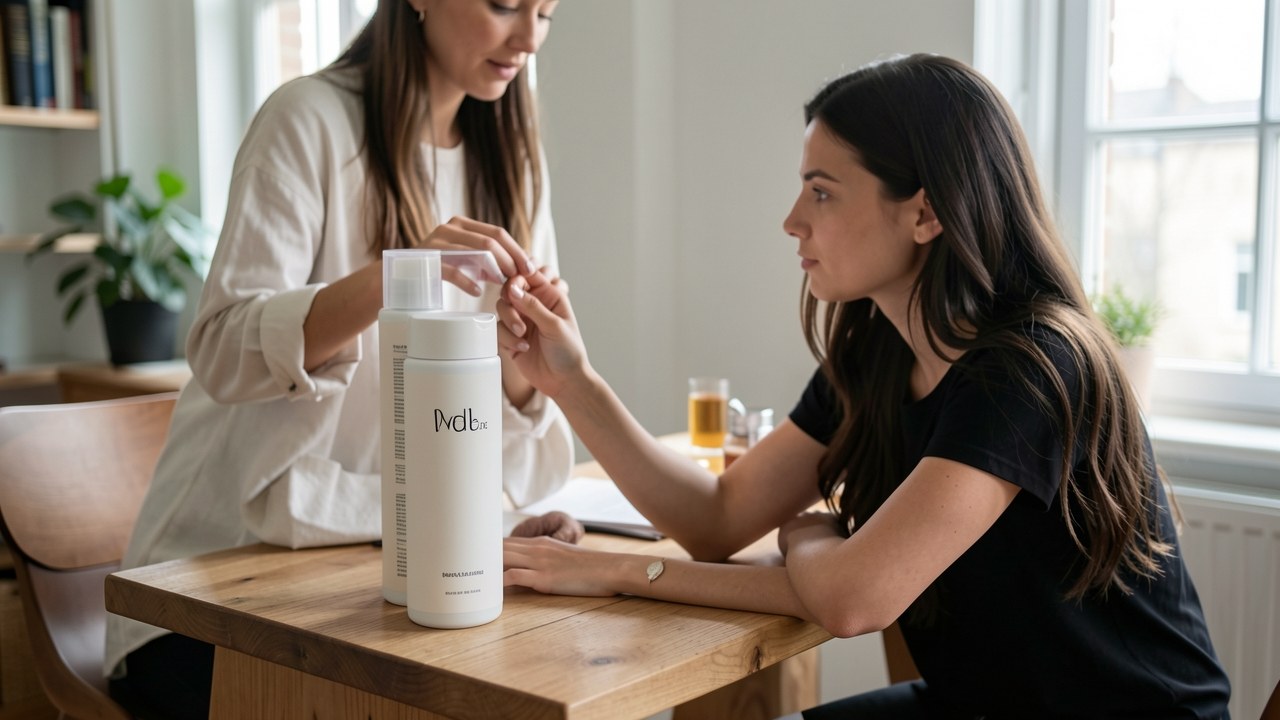
What US hair product labels typically include
A hair product label is a small packaging surface that has to carry several different kinds of information at once. For a US shopper, the practical starting point is to separate the label into zones: the front panel that names the product and its main claim, the back panel that carries directions and warnings, the ingredient list, and the smaller marks such as the open-jar symbol.
Read the front panel last. Claim words are the part of the label written by marketing, and they are the part most likely to be interpreted loosely. The back panel and the ingredient list are where the more standardized information sits.
The open-jar symbol, often called PAO, shows the number of months a product is recommended for safe use after opening, for example 12M for twelve months. It is one of the few label elements with a direct use instruction attached, and it is easy to overlook.
- Front panel: product name, product type and the main marketing claim.
- Back panel: directions for use, warnings and company or distributor information.
- Ingredient list: standardized ingredient names, usually in descending order of concentration.
- Open-jar or PAO symbol: the recommended number of months of use after opening.
- Net quantity: the amount of product in the package.
Sources: Better Not Younger, FUL London, Paramount Global
How to read an ingredient list in order
Ingredient lists on cosmetics and personal care products generally follow a concentration logic: ingredients are listed in descending order, with the highest-concentration ingredients first. Ingredients present above 1 percent are ordered; ingredients at or below 1 percent may be listed in any order. That single rule explains why two bottles in the same category can look so different even when they perform a similar job.
Cosmetic ingredient names are usually written using INCI, the International Nomenclature of Cosmetic Ingredients. INCI is a naming system, not a quality rating, and its main benefit for a shopper is consistency: the same ingredient should carry the same name across brands, so a term learned on one bottle can be recognized on another.
Water or Aqua is commonly the first ingredient in many water-based hair care and styling products because it is the main solvent or base. Seeing water first is not a sign of a weak formula; it is a sign that you are reading a water-based product.
The top several ingredients account for the bulk of a formula, so the first few lines are the most useful place to start. Lower placement does not automatically mean an ingredient is unimportant: some ingredients work at levels below 1 percent, and some have use restrictions that keep them low on the list.
- Check that the list is present and legible. A missing or unreadable ingredient list is a reason to pause before buying.
- Read the first three to six ingredients. These usually describe the base of the product.
- Identify the product type from the base: water-based, oil-based, or a thick cream or paste.
- Scan the middle of the list for the functional group you care about, such as cleansers or conditioning agents.
- Read the tail of the list for preservatives, fragrance, colorants and other low-level ingredients.
- Check the open-jar symbol and the directions before deciding how the product fits your routine.
Sources: Better Not Younger, FUL London, Cliphair, Church California Pro
Common cleanser and conditioner ingredient terms
Cleansers in hair products are surfactants. The term covers a large family of ingredients that share one job: lifting oils, dirt and product residue so they can be rinsed away. Sulfates such as sodium lauryl sulfate and sodium laureth sulfate are a well-known group within that family. Sulfate-free products generally avoid sulfate surfactants and use other cleansers instead.
Surfactants can be harsh on some hair types or scalps and may strip oils, which is why some shoppers look for milder cleansing systems. That is a description of how the ingredient class behaves, not a rule that every sulfate is wrong for every person or that every non-sulfate cleanser is gentle.
Conditioning ingredients sit on a different part of the label. They are the ingredients that help with softness, slip, detangling and surface smoothness. You will usually find them after the water and the primary cleansers, in the middle of the list.
A useful habit is to group the list by function rather than reading it line by line. Ask three questions: what is the base, what is doing the cleaning, and what is doing the conditioning? That structure is more informative than treating each name as an isolated verdict.
- Surfactants: the cleansing family; sulfates are one well-known group within it.
- Sulfate-free: the product does not contain sulfate surfactants such as sodium lauryl sulfate or sodium laureth sulfate, and typically uses other cleansers instead.
- Conditioning agents: ingredients that help with softness, slip and detangling; they usually appear after the water and primary cleansers.
- Emollients and oils: ingredients that add a lubricating or smoothing feel, often in the middle or lower part of the list.
- Thickeners and texture agents: ingredients that give the product its body and spreadability.
Sources: Better Not Younger, Clinikally, Davines, Cliphair
Common claim terms and what they mean
Claim terms are the most loosely defined part of a hair product label. Words such as natural, clean beauty, hypoallergenic and chemical-free can be vague, and in the US cosmetic context they may lack standardized regulatory definitions. That does not make every claim meaningless, but it does mean the word alone does not tell you what a product contains.
The practical response is to treat claims as questions rather than answers. If a bottle says natural, the useful follow-up is: which ingredients are being counted, and what is being left out of the count? If a bottle says hypoallergenic, the useful follow-up is: what testing or definition sits behind the word?
Sulfate-free is a more concrete claim than most, because it points at a recognizable ingredient group. Even so, it says what is absent, not what is better. A sulfate-free product can still be drying for some hair, and a product with sulfates can still be the right choice for someone whose routine depends on stronger cleansing.
Fragrance claims deserve their own check. Fragrance-free products contain no added fragrance or parfum, while unscented products may still contain a masking fragrance to neutralize odors. Those two labels are not interchangeable.
- Natural: commonly vague and not a standardized US cosmetic regulatory category.
- Clean beauty: a marketing category rather than a defined regulatory term.
- Hypoallergenic: a claim word that does not tell you by itself which ingredients are present or absent.
- Chemical-free: difficult to interpret literally, since all ingredients are chemicals in the ordinary sense.
- Sulfate-free: points to a specific ingredient group, but does not by itself predict how a product will feel.
- Fragrance-free vs unscented: fragrance-free means no added fragrance or parfum; unscented may still include a masking fragrance.
Sources: Better Not Younger, FUL London, Clinikally, Cliphair
Fragrance and preservatives in plain language
Fragrance is often written on a US label as a single line, typically Fragrance or Parfum. A label may list that one term without disclosing every component behind it, and it is common for shoppers to find only the generic word on the list. The practical consequence is simple: the word Fragrance on a list does not tell you how many fragrance ingredients are behind it.
That is not an argument against fragrance. It is an argument for reading the label honestly. If fragrance matters to you, the label is more useful for finding the word and knowing it is present than for telling you what is inside it.
Preservatives perform a different job. Water-based hair care products need preservatives to prevent bacteria, mold or fungi and to keep the product stable and safe over its use period. A product with water high on the list and no preservative system would be a formula that is difficult to keep stable.
Parabens are one family of preservatives, and paraben-free labeling means the product avoids ingredients whose names end in paraben, such as methylparaben or propylparaben. The label tells you whether that family is present. It does not tell you whether the preservative system that replaced it is better or worse for your hair.
- Fragrance or Parfum: a single line that may stand in for multiple fragrance ingredients.
- Fragrance-free: no added fragrance or parfum.
- Unscented: may still contain masking fragrance used to neutralize odors.
- Preservatives: used in water-based products to prevent microbial growth and keep the product stable.
- Paraben-free: the formula avoids ingredients whose names end in paraben; it does not by itself say what replaced them.
Sources: Better Not Younger, FUL London, Clinikally, Davines, Church California Pro
How to compare two similar products
Comparing two similar products is a labeling exercise, not a personality test. The goal is to find the real differences between the formulas in the categories that matter to you, and to notice when two products are more alike than their packaging suggests.
Start at the top of each list and read the first several ingredients side by side. If both start with water, they share a water base. If one lists a sulfate cleanser near the top and the other lists a different surfactant, that is a real difference in the cleansing system.
Move to the middle of the list and compare the conditioning ingredients. Two products can share a base and a cleanser and still part ways here, which is often what makes one feel heavier, lighter, slicker or more detangling than the other. Then compare the tail: fragrance, preservatives, colorants and the ingredients that appear at or below 1 percent. Because very low-concentration ingredients may appear in any order, do not draw strong conclusions from small differences at the bottom of the list.
Finish with the non-ingredient parts of the label. Check the open-jar symbol, the directions, and the claim wording. A product with a 6M symbol and one with a 24M symbol are making different statements about how long the formula is intended to be used after opening, even if the ingredient lists look close.
- Line up the first several ingredients from each list and note what the two products share.
- Compare the cleansing system: the surfactants near the top of each list.
- Compare the conditioning group in the middle of each list.
- Compare the tail of each list, and remember that ingredients at or below 1 percent may appear in any order.
- Check the open-jar symbol and the directions on each package.
- Compare the claim wording last, and treat each claim as a question about the formula rather than a conclusion.
Sources: Better Not Younger, FUL London, Cliphair, Church California Pro
Common label-reading mistakes
The most common mistake is reading the ingredient list as a ranking of good and bad. Order tells you about concentration, not about whether an ingredient belongs in your routine. An ingredient near the top of the list is present in a larger amount; it is not thereby a problem, and an ingredient near the bottom is not thereby unimportant.
A second mistake is treating claim words as regulated definitions. Terms such as natural, clean beauty, hypoallergenic and chemical-free can be vague in the US cosmetic context, so a claim on the front panel is a starting point for looking at the ingredient list, not a substitute for it.
A third mistake is stopping at the first few lines. The top of the list is the best starting point, but the middle and the tail carry the conditioning agents, the fragrance line and the preservatives. Skipping them means missing the parts of the formula that most often differ between two otherwise similar products.
A fourth mistake is assuming that lower placement means an ingredient does not matter. Some ingredients work at levels below 1 percent, and some are restricted in how much can be used. Read position as one signal among several, alongside the product type, the directions and the open-jar symbol.
- Treating the list as a good-versus-bad ranking instead of a concentration order.
- Reading claim words as if they had a standard regulatory definition.
- Stopping after the first few ingredients and ignoring the middle and the tail.
- Assuming a low position on the list automatically means unimportant.
- Confusing fragrance-free with unscented.
- Overlooking the open-jar symbol and the directions.
Sources: Better Not Younger, FUL London, Clinikally, Cliphair, Church California Pro
A short label-reading routine you can reuse
A reusable routine keeps the process short. The version below is intended to be quick once familiar, and it works on a bottle in a store aisle or at home.
The routine also keeps you honest about what the label can and cannot tell you. It can tell you the base, roughly how much of each ingredient is present in relative terms, which functional groups are in the product, whether fragrance is present, and when the product is intended to be used up after opening. It cannot tell you how the product will perform on your own hair, which is why the routine ends with a decision about trying it rather than a verdict from the list alone.
- Find the ingredient list and confirm it is complete and readable.
- Read the first several ingredients to identify the base and the cleansing system.
- Read the middle of the list for the conditioning group.
- Read the tail for fragrance, preservatives and other low-concentration ingredients.
- Check the open-jar symbol and the directions.
- Read the front-panel claims last, and translate each one into a question about the formula.
- Compare with a product you already use, ingredient group by ingredient group.
Sources: Better Not Younger, FUL London, Cliphair, Church California Pro
Frequently asked questions
Does ingredient order on the label tell me how much is in the product?
It tells you about relative concentration, not exact amounts. Cosmetics ingredient lists are generally written in descending order of concentration: ingredients present above 1 percent are ordered, while ingredients at or below 1 percent may be listed in any order. So the top of the list is the most informative place to start, but you cannot read a percentage off a position, and small differences near the bottom of the list should not be overinterpreted.
Sources: Better Not Younger, FUL London, Cliphair, Church California ProWhat does 'sulfate-free' actually mean on a label?
It generally means the product does not contain sulfate surfactants such as sodium lauryl sulfate or sodium laureth sulfate, and typically uses other cleansers instead. It is a statement about what is absent from the cleansing system, not a statement that the product will be gentler or better for your hair. A sulfate-free formula can still feel drying for some hair types, and a product containing sulfates can still suit someone whose routine depends on stronger cleansing.
Sources: Better Not Younger, ClinikallyAre all 'natural' ingredients safer for hair?
The word natural is not a reliable safety signal on its own. In the US cosmetic context, natural and similar terms such as clean beauty can be vague and may lack standardized regulatory definitions, so the word does not tell you which ingredients are in the product or how they will behave. Ingredient safety and suitability depend on the specific substance, its concentration and your own hair and scalp, not on whether the word natural appears on the front panel.
Sources: Better Not Younger, FUL London, Clinikally, CliphairWhy do two similar products have very different ingredient lists?
Two products can do a similar job with different formulas, and the label reflects that. A shampoo and a conditioner, or two shampoos aimed at the same hair type, may use different surfactants, different conditioning agents, different fragrance systems and different preservative systems. Base ingredients such as water may be shared while the rest of the formula diverges. The way to compare them is group by group: base, cleansing system, conditioning group, then the tail of the list including fragrance and preservatives.
Sources: Better Not Younger, FUL London, Cliphair, Church California ProWhy is fragrance listed as one word instead of a full list?
In the US, fragrance formulas can be treated as trade secrets, so a label may list Fragrance or Parfum as a single line item without disclosing every component behind it. That means the word Fragrance tells you fragrance is present, but not how many fragrance ingredients are in the product. If fragrance matters to you, the label is most useful for confirming its presence rather than for identifying the individual components.
Sources: Clinikally, Church California ProWhat is the difference between fragrance-free and unscented?
Fragrance-free products contain no added fragrance or parfum. Unscented products may still contain a masking fragrance used to neutralize the natural odor of the other ingredients. The two terms are not interchangeable, so if you are looking for a product with no fragrance added at all, fragrance-free is the term to look for on the label.
Sources: Better Not Younger, FUL LondonDo water-based hair products need preservatives?
Yes, water-based hair care products need preservatives to prevent bacteria, mold or fungi and to keep the product stable and safe over its period of use. That is why a water-based formula with water high on the ingredient list will normally include a preservative system further down. Parabens are one family of preservatives; paraben-free labeling means the product avoids ingredients whose names end in paraben, such as methylparaben or propylparaben.
Sources: Clinikally, Davines, Better Not Younger, FUL LondonWhat does the open-jar symbol on the label mean?
The open-jar symbol, sometimes called PAO, indicates the number of months a product is recommended for safe use after opening. A symbol reading 12M means twelve months after opening; 6M means six months. It is a use-period statement about the product after the package is first opened, and it is worth checking alongside the directions and the rest of the label.
Sources: Better Not Younger, FUL LondonSources
- How to Read Hair Product Labels Like a Pro | BNY — Better Not Younger
- Decoding Hair Product Labels: Ingredients You Should Know – FUL — FUL London
- Understanding Haircare Labels: A Complete Guide to Healthy Hair — Clinikally
- How to Read and Interpret Hair Product Labels - Davines — Davines
- How To Read Hair Labels Like A True Pro | Cliphair US — Cliphair
- A Complete Guide to U.S. Product Labeling Requirements — Paramount Global
- How to Read Cosmetic Labels: A Practical Guide for Pros – Church California Pro — Church California Pro